Research has shown that the mere existence of a mission statement does not have a strong correlation with improved financial performance—but that strong mission statements do. Some companies, in their haste to create corporate mission documents, ended up with statements that do not resonate with their audiences or cannot stand the test of time.
These rushed company mission statements often share at least one of three fatal issues, as outlined by Inés Alegre in the Journal of Management and Organization:
The 3 Attributes of Failed Corporate Mission Statements
1. They were delegated to subordinates by disinterested executives
Alegre notes that in the ’80s and ’90s, the common approach to mission statement formulation was for top management to delegate the initial drafting to their subordinates and then review subsequent drafts until the CEO was satisfied. This method was time-consuming and did not provide the greater team involvement necessary to permeate the mission throughout the organization.
In an attempt to work more efficiently through delegation, these companies often spent more time revising drafts than they would have creating a proper, collaborative mission statement from the get-go.
2. They were the only documents summarizing organizational strategy for employees
Without enriching materials, programs and events, and without complementary initiatives like purpose, vision, and values, mission statements don’t pack much of a punch. To create value, they must be frequently and consistently reiterated, exemplified and modeled.
Offering employees only one way to consider your “Why” is likely to be ineffective—particularly when such a statement is packed with buzzwords and “corporate-speak,” as the first mission statements often were.
3. They were static documents that didn’t reflect their company’s changing world
We’ve heard it trumpeted again and again: our world is moving fast. So it’s difficult to write a mission statement that feels relevant for 10 (or even five) years. But while specific performance goals may date a statement too quickly, erring on the side of vagueness may also abstract the statement from employees’ everyday worlds. It’s a tricky balance between static and soft. But it’s vital that companies try to find it.
Subscribe to Our Newsletter
Purpose, Mission, Vision, Values 101
A lot of terms get thrown around in discussions of corporate mission statements, brand purpose, and core brand values. Too often, these terms are used interchangeably—or, worse, to refer to brand strategy deliverables such as positioning. Here’s a brief primer of terms you need to know and what you need to do relative to them.
Brand Experience Principles
Sometimes known as brand behavior or brand principles, these guidelines define how the company interacts across touchpoints, physical and digital. To maximize value creation, leaders have to operationalize the company’s mission, vision, values and purpose for employees by giving them clear directions on how to implement them in their outlooks and in their day-to-day work—and this is what brand experience principles provide.
This well-known set of brand experience principles once defined Facebook (pre-2014):
- Move fast and break things
- Do not let a competitor get ahead of you
- Adhere to the process
- Create an exciting workplace
The “Big, Hairy, Audacious Goal” (BHAG)
This is a far-in-the-future goal that may change the very nature of a company’s business. Here’s GE’s version:
- To become #1 or #2 in every market we serve and revolutionize this company to have the speed and agility of a small enterprise
Brand Promise
Your brand promise is the experience or value that a customer can expect to have at each of a brand’s touchpoints; the term is also closely related to customer experience design. REI’s brand promise is a good example:
- Bringing the outdoors into the retail experience
Mission
Your mission is a statement that describes the company’s business and operational goals now and in the near-term, and it is designed to focus on leadership and employees. It can also provide a clear explanation of what the business is and isn’t. Consider Warby Parker’s:
- Warby Parker was founded with a rebellious spirit and a lofty objective: to offer designer eyewear at a revolutionary price, while leading the way for socially conscious businesses
Purpose
Your purpose is your ultimate “Why”: the reason your company exists for external audiences—notably customers and the world at large. It should be written from an external perspective, placing employees in the shoes of buyers and community-members. Here’s an example from EY:
- Building a better working world
Values
Your values are your organization’s core beliefs, defining the company’s culture and guiding leadership’s decision making. Here are a memorable set of values from Swedish shipping line Maersk, notably grounded in humbleness:
- Listen, learn, share and give space to others
- Showing trust and giving empowerment
- Having an attitude of continuous learning
- Never underestimating our competitors or other stakeholders
- Acknowledging our limits and mistakes
Vision
Often articulated by company leadership, your vision lays out what the company wants to achieve in the future, usually several years down the road. EY has a nice example of brand vision:
- By 2020, we will be a US$50 billion distinctive professional services organization
Focus on Brand Purpose
If you take anything from this list of terms and examples, let it be this: purpose and mission are different. Mission is what you come to work every day to achieve, but purpose is why what you do matters for the world. This means that in terms of your brand, purpose is where your attention should be focused first.
Here’s a great example of this from Disney:
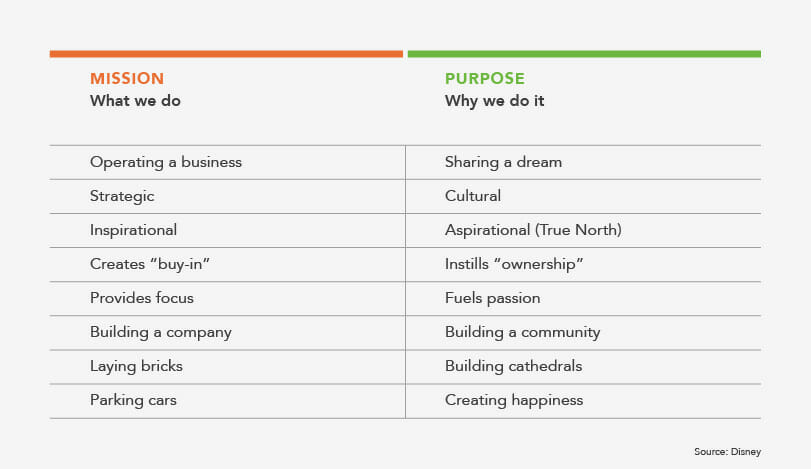
This isn’t to say that internal perspectives aren’t important; they are. However, in Harvard Business Review, Graham Kenny writes that not only are customer-centric purpose statements more resonant with customers, they are also more effective in rallying employees, as they “connect with the heart as well as the head.”
Focusing on purpose doesn’t mean ignoring other traditional brand mission, vision and values initiatives. It just means understanding that all of these ladder up to purpose. Values enrich the brand mission and vision, which in turn support and operationalize brand purpose.
Eager to get started? Here are four steps to building a resonant, enduring brand purpose.
How to Build Your Brand Purpose
Increasingly, companies are investing in “brand purpose” – a clear reason for existing beyond just making money – because the business environment has shifted in significant ways:
- Consumers expect values, not just products and services. Younger generations in particular are choosing brands that align with their beliefs. Research in marketing and consumer psychology shows that customers are more loyal to companies they feel share their values.
- Differentiation in crowded markets. In many industries, products are very similar in quality and price. Purpose becomes a way to stand out.
- Employees want meaning at work. As workers increasingly seek jobs that feel meaningful, companies can deploy a purpose-led brand to attract better talent, improve employee engagement, and reduce turnover.
- Trust and reputation matter more than ever. With the ubiquity of social media, companies are constantly under scrutiny. A well-defined purpose can build trust that endures through good times and bad.
Building a purpose-led brand requires a significant investment in time and resources, and the process will differ for every organization depending on its marketplace and internal dynamics. However, four key imperatives should drive every brand purpose initiative.
1. Invest in employee engagement
Creating your brand’s purpose, mission, vision and values in a vacuum drastically increases the chances they will fall flat and fail to resonate.
Employees need to be able to envision how the business’s purpose, mission, vision, and values (PMVV) apply to their day-to-day lives. Ideally, they will have a part in the PMVV process. But if not, they need to understand and buy into it.
A true bottom-up approach to brand purpose includes employees through input sessions and feedback loops.
- This could take the form of company-wide surveys, departmental workshops or town halls.
- Employee involvement shouldn’t stop when the document is created. Ongoing employee engagement programs are necessary to spread and maintain awareness of how purpose is relevant to individuals, as well as to gauge whether refinements are needed as contexts shift.
- On an ongoing basis, employee engagement can and should take multiple forms: environmental branding, training, ambassador programs, and awards programs are just a few tactics.
2. Show enthusiastic executive modeling
Employee involvement is vital, but it’s hard to secure it without a visible and compelling commitment from executives. Brand purpose work can’t look like it is the purview of HR or marketing; it needs to be clear it is an organization-wide initiative, dependent on everyone’s participation.
CEO as champion. One of the most powerful symbols of change is a CEO who champions it. The CEO, and other executives, should make a point of introducing and endorsing the initiative, its day-to-day project leaders, and its results. This will help assuage concerns that brand purpose is an empty promise and it will encourage active participation across the organization.
In addition to being active in the project’s roll out, leadership needs to show how it affects even boardroom behavior. This modeling could take the form of:
- Regular communications
- Leadership blogging
- Purpose roadshows
- Operational changes such as updated compensation schemes or reporting structures.
Maersk does a great job emphasizing its leadership’s stalwart belief in its corporate values. The company prominently displayed richly produced videos of the Möller-Maersk family musing on the importance of its uniquely Scandinavian values—and enriched leadership’s stories with videos of everyday employees speaking about the same corporate beliefs.
3. Strive to stand out
One of the reasons that brand purpose, mission, vision and values often get a bad rap is because too many companies have used them as corporate hygiene instead of as a differentiator. Marty’s informal study of brand values in a group of 40 companies shows that, for example, 62.5 percent of companies include integrity and 57.5 percent include performance.
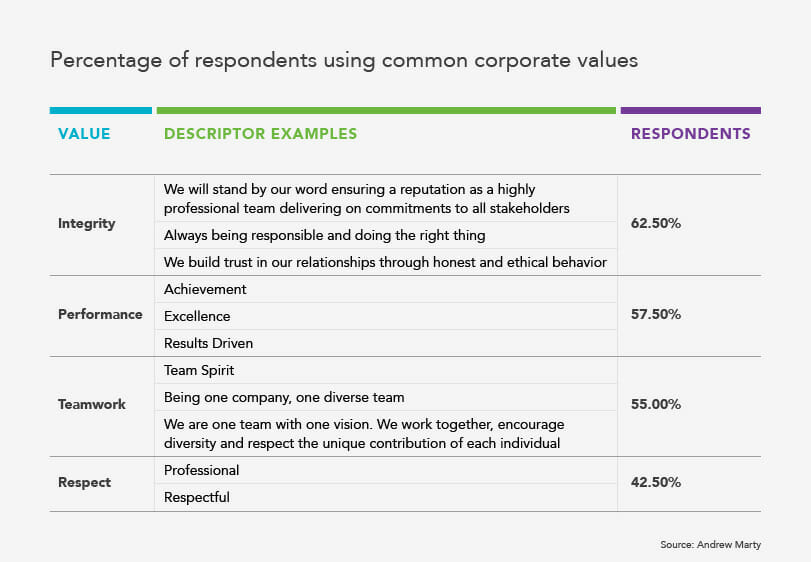
This is no place to affirm table stakes. Ideally, customers and stakeholders expect your company to be responsible, collaborative, and profitable. Instead, this is an opportunity to highlight what differentiates your culture and strategy. Not only should your high-level concepts be unique, you also should express them using clear and “human” language. Nothing sparks skepticism like words such as “synergies” or “disruption.”
SquareSpace’s values are a good example of values that deviate from the norm—in a good way. With just a few words, they give the reader an impression of what it’s like to work with or for the organization:
- Be your own customer
- Empower individuals
- Design is not a luxury
- Good work takes time
- Optimize towards ideals
- Simplify
4. Build your brand purpose, mission, vision and values to flex
Academic research on mission statements of the ’80s and ’90s found that many were too static—leading to them quickly feeling stale and irrelevant to employees and customers. By making purpose the hero (rather than mission or vision), a company can mitigate some of the risk that comes from focusing too heavily on of-the-moment metrics or processes. Nonetheless, a conscious effort should be made to “future proof” visioning documents so they can continue to guide and inspire for many years to come.
“Future proofing” means both careful consideration and pragmatic iteration. Of course, efforts should be made to write something that is simultaneously timely and timeless. But since this is all but an impossibility, resources should be created and shared in ways that allow for—and even encourage—incremental change. This means both their structure and their medium should be built to flex, something that might be necessary after M&A, market changes, divestment, employee feedback, or (with luck) after goals have been achieved!
Remember, in our digital world, writing and designing for change is easier and more important than ever. So always consider: How can documents be formatted for seamless editing? How can they be disseminated and promoted in adaptable ways?
The takeaway: Clarify your “why”
Your brand purpose, mission, vision and values play an increasingly vital role engaging employees and building brand esteem and equity in the market. With purpose-driven generations flooding the workforce (working both with you and for you), and decades of validation for the strategy, clarifying your “Why” will remain vitally important moving forward.
Want to discuss how a clear brand purpose can drive value creation for your organization? Let’s talk.
Originally published January 18, 2020.